Choosing a new mountain bike can be an exciting but sometimes confusing experience. Today's bicycles are more technological than ever, and the variety of styles, geometry, suspension, and sizes can challenge even experienced riders. In this guide, we will explain the most important factors you should consider when buying mountain bike, whether you shop online or in bike shop.
1. Determine what kind of riding you prefer
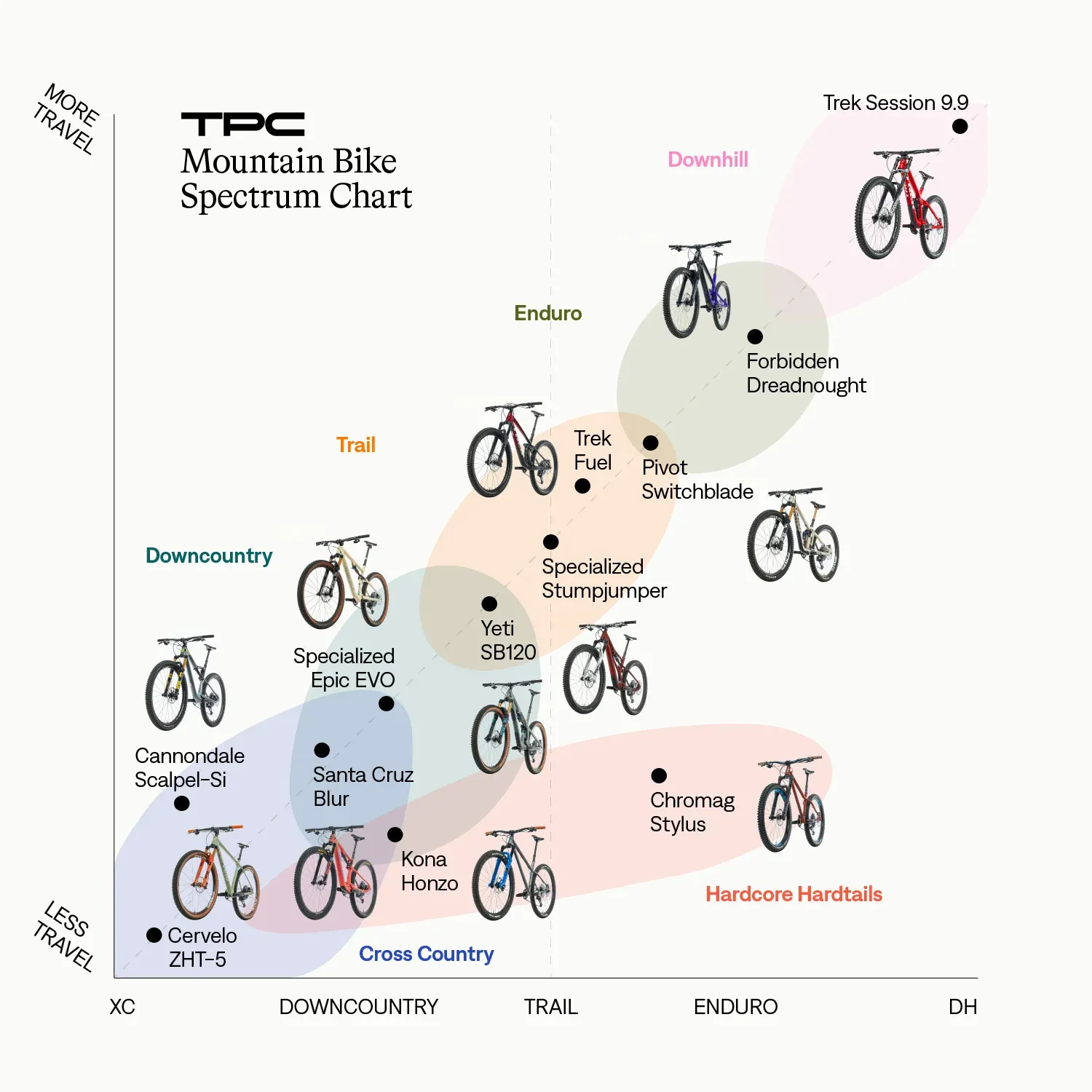
The first step is to know where and how you will ride. This determines the main type of bike:
Trail bikes (the versatile choice)
Trail models are ideal for 90% of riders — suitable for varied terrains, including technical trails, light descents, and climbs.
- Suspension: 120–150 mm
- Geometry: stable and versatile
- Suitable for: hobby riding, mixed terrain, tours, beginners and intermediate riders
All-mountain / Enduro
These bikes are for more aggressive riding and steep trails.
- Suspension: 140–170 mm
- Advantage: stability at high speeds and technical sections, while still allowing pedaling back to the start of the track.
- Suitable for: advanced riders, bike park riding, enduro racing
Cross-country (XC)
Light, fast, and made for efficiency.
- Suspension: 100–120 mm
- Advantage: excellent for climbs
- Suitable for: long distances, marathons
Electric Mountain Bikes (e-bike / ebike)
Perfect for people who want to ride longer, don't have enough time, and climb more easily.
- Motor: from 20Nm to over 110Nm
- Batteries: 300 to over 800 Wh
- Popularity: rapidly growing among both beginners and experienced riders.
2. Hardtail or Full Suspension?
One of the most important dilemmas when choosing a mountain bike is whether it should be a hardtail or full suspension.
Hardtail mountain bike
- Front suspension only
- Lighter and cheaper
- Easier maintenance
- Great for Cross Country (XC), beginners or people with a limited budget
- Limited to technical trails
Full Suspension
- Front and rear suspension
- More comfortable on rocks, roots, and technical trails
- Better control at high speed
- Ideal for trail, all-mountain and e-MTB
- Heavier
- More maintenance
- More expensive
3. Choosing the Right Bike Size
The correct frame size is critical for stability, control, and comfort.
Manufacturers (Cube, Trek, Specialized, etc.) provide sizing charts based on height.
Usually:
- 150–165 cm → S
- 165–175 cm → M
- 175–185 cm → L
- 185+ cm → XL
But we should not take this data as a strict rule. Some people prefer shorter wheels, others – longer ones. It's best to test everything in practice. The topic is extensive, so we will explore it in more detail in a separate article.
Drops (tires/wheels): 27.5", 29" and Mullet (29" front + 27.5" rear)
The wheel size plays a huge role in the bike's behavior. It determines how it accelerates, how it handles corners, how it overcomes obstacles, and how it feels in terms of dynamics. Today, the most popular standards are 27.5", 29", as well as modern hybrid configurations – Mullet.
27.5" — playfulness and maximum maneuverability
This size remains preferred by many riders who seek dynamism, quick response, and control on technical sections.
Advantages:
- More maneuverable in sharp turns
- Lighter compared to 29"
- Faster acceleration
- More suitable for shorter riders
- Easy to master tight switchbacks
Suitable for:
- technical trails with many turns
- enduro riding
- shorter riders (under 170–175 cm)
- enthusiasts of the "playful" feel of trail riding
Disadvantages:
- harder to pass over stones and roots
- less stability at high speed
29" — stability, speed, and efficiency
29-inch wheels are the undisputed standard for trail and XC bikes, thanks to their excellent performance on varied terrains.
Advantages:
- More stable at high speed
- Better on climbs
- They overcome obstacles (rocks, roots, holes) more easily
- Better grip due to the larger contact area
- More control in long, fast turns
Suitable for:
- Trail, XC and all-mountain riding
- Long routes
- People who want speed and efficiency
- Higher riders, but now they also work well with lower ones
Disadvantages:
- heavier
- a bit slower acceleration
- may feel "clunky" in very tight sections
Recommended for most trail/XC bikes
That is why almost all new models from Cube, Canyon, Trek, Specialized, and others are mainly offered in 29".
Mullet — the modern hybrid configuration (29" front + 27.5" rear)
Mullet (also known as "mule") combines the best of both worlds and is becoming an increasingly popular configuration for enduro, freeride, and even trail bikes.
What is a Mullet setup?
- Front wheel: 29" — stability, better obstacle clearance
- Rear wheel: 27.5" — maneuverability, aggressive feel in the corners
This combination delivers remarkably confident and fun riding.
Advantages of the Mullet configuration:
- Easier cornering thanks to 27.5" rear wheel
- Great stability in technical sections with 29" front wheel
- Better angle for drops and jumps
- Easier lift of the rear end during bunny hops
- Comfort and control at high speed
Suitable for:
- Enduro
- Aggressive trail
- Bike park riding
- People who want a more “playful” character but don’t want to lose the stability of 29"
Disadvantages:
- Some bikes are not designed for Mullet setups and the geometry may change.
- Slightly more expensive maintenance due to different standard parts
- Smaller selection of ready-made factory kits (although the number grows every season)
Why has Mullet become so popular?
Professional racers in DH and Enduro like Loïc Bruni, Finn Iles, and Amaury Pierron started winning races with a Mullet setup — manufacturers then followed the trend. Today, almost all high-end models have a Mullet option.
4. Suspension: how much travel do I need?
Suspension on mountain bikes is measured in millimeters of travel and directly affects the terrain where the bike feels most comfortable. The greater the travel, the more comfort and control you have on difficult sections, but at the expense of pedaling efficiency.
For XC riding usually a travel between 100 and 120 mm. This allows for maximum lightness and efficiency, as the bike does not "sink" during pedaling and climbs are faster and more stable.
At trail bikes the travel increases to 120–150 mm, making them the most versatile choice. They can handle both light technical trails and steep descents without losing too much efficiency on climbs.
All-mountain models offer even more control with their 140–170 mm travel. They provide stability and confidence during more aggressive descents, large rocks, roots, and higher speeds.
If you ride enduro, the standard is 160–180 mmThis range is designed for very technical and steep terrain, as well as for riders who love jumps, drops, and more challenging trails.
Finally comes downhill bikes, which use the largest travel – over 180 mm, reaching 200 mm or more. Such models are designed exclusively for bike parks and descents with carefully selected steep trails, serviced by a lift or other transport. They are heavy but offer maximum stability and control at very high speeds and rough terrain.
5. Frame Materials
The frame material is one of the key factors that determine the feel, weight, and price of a mountain bike. The most common options are aluminum and carbon, with each of them having its own advantages depending on needs and budget.
Aluminum is the most common material for mountain bikes. It is strong, reliable, and relatively lightweight, while remaining affordable for the average rider. It offers an excellent price-to-quality ratio, withstands stress, and is easy to maintain. That’s why aluminum frames are the primary choice for most riders, including beginners and those seeking maximum value for their budget.
Carbon frames are the next step up – they are lighter, stiffer, and provide better bike response during aggressive riding. Carbon allows for more precise shapes and geometry, which can improve control and vibration damping, but comes at a higher price. Therefore, it is most commonly used in higher-end XC, trail, enduro, and race models.
6. Components That Really Matter
Speeds and gears
Most modern mountain bikes use 1x systems:
- 1x10
- 1x11
- 1x12 (most popular)
They are lighter and easier to use.
Brakes
Hydraulic disc brakes are a must-have:
- more power
- better feeling
- short braking distance
Tires — tubeless?
Tubeless tires reduce the risk of punctures and allow for lower pressure for better traction. In some cases, inserts are added for enduro and downhill to protect the tire from impacts.
Bicycle grips
Don’t underestimate — quality grips improve control, comfort and reduce fatigue in the hands.
7. Electric bike or standard bike?
If you often ride long routes or climbs, electric bicycle It is an extremely comfortable and increasingly popular choice – in fact, it is already one of the most widespread types of mountain bikes. Modern e-MTB models allow you to cover the same routes faster and with much less fatigue, while enabling more people to enjoy mountain biking without limitations in training.
Advantages:
- less fatigue during long climbs
- ability for longer distances and more laps in the same time
- ideal for entering more difficult terrains and trails
- give you a chance to ride with stronger friends without falling behind
Thanks to the electric assist, instead of doing 2 descents after work, you can easily do 3–4 on the same trail, without overexerting yourself. This way you actually spend even more calories, because you ride longer, not because you suffer more.
Disadvantages:
- higher price than standard models
- greater weight
- need for battery charging and care
At Nameri Bike, we often offer electric mountain bikes at significantly better prices compared to new ones, making entry into the e-MTB world much more accessible.
8. Children's bicycles — what should we know?
For parents who are looking for children's bicycle, the leading factors are:
- wheel size (16", 20", 24")
- bicycle weight
- brake system
- low frame for easy mounting
24" mountain bikes are suitable for 9–13 year old children and already allow real trail riding.
9. Buying a Used Bicycle
The purchase of second-hand bicycle is one of the smartest investments if you know what to look for.
Check carefully:
- crack detection on the frame
- fork travel
- the condition of the brakes
- Do the gears shift smoothly?
- the tires and the rims
check out our topic on used bike inspection here
Exactly for that reason, many people choose Nameri Bike - the largest Bulgarian platform for quality second-hand bicycles.
Conclusion
The choice of mountain bike It doesn't have to be difficult. Once you determine your riding style, budget, suspension type, and sizes, the options become much clearer. Whether you're looking for a versatile trail bike, a more aggressive all-mountain model, or an electric bike for longer adventures—the most important thing is to find a bike that gives you confidence and enjoyment on the trail.
If you want to save money and get a higher-class bike, check out the current offers for used ones. bicycles in Nameri.bike — the place where quality and affordability meet.